When a standard move becomes a specialised project
Discover how Specialised Movers completed a complex fireproof safe installation using scaffolding, a HIAB crane, and a first-floor window access solution.
Specialist movers were called in by The Potteries Museum and Art Gallery to tackle two jobs that were unusual even by our standards.
The museum is undergoing a major refurbishment, including asbestos removal and the creation of new viewing galleries designed to enhance the visitor experience. Unfortunately, one existing wall stood directly in the way. Under normal circumstances, the builders would simply have demolished the wall and sent the rubble off to a skip—but this was no ordinary wall.
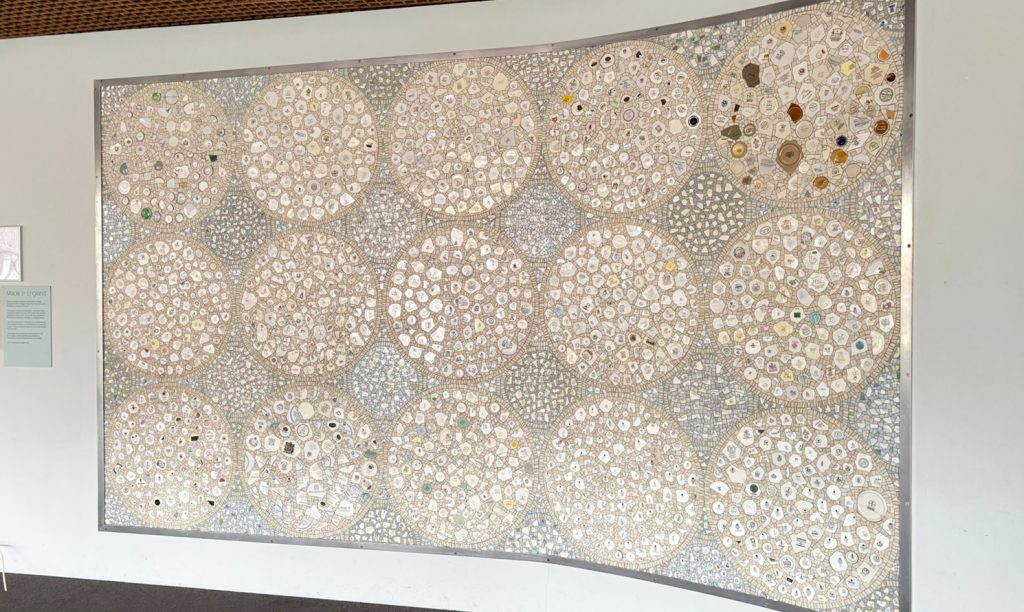
Affixed to it was a remarkable tiled mural composed of small ceramic pieces featuring pottery marks and signatures—the distinctive stamps usually found on the underside of pots. These marks celebrated the illustrious heritage of Stoke-on-Trent and its six towns, bearing famous names from the region’s extraordinary past. Among them were Spode, whose pottery graced the RMS Titanic; W.H. Grindley & Company, manufacturers of ceramics for the dining cars of the Great Western Railway; Moorcroft, whose work was sold through Harrods and Tiffany & Co; and Minton, creators of the renowned dessert service for Queen Victoria and the Great Exhibition of 1851. Clearly, this wall demanded careful preservation.
Our initial survey quickly revealed a problem: the wall was curved and supported only halfway along its length. Attempting to move it as a single piece risked cracking—or worse, snapping—the mural entirely. That, of course, was unacceptable. After many hours spent devising a way to reinforce the structure for safe movement, the artist who originally created the mural suggested an elegant solution: carefully cut the artwork in half using a diamond saw. He would then reframe it as two separate murals, preserving all the pottery marks and signatures.
Once cut, the sections of wall were lifted onto sliding supports and carefully moved to the opposite side of the room. There they will remain until the building work is nearly complete, at which point they will be relocated to their new permanent positions.
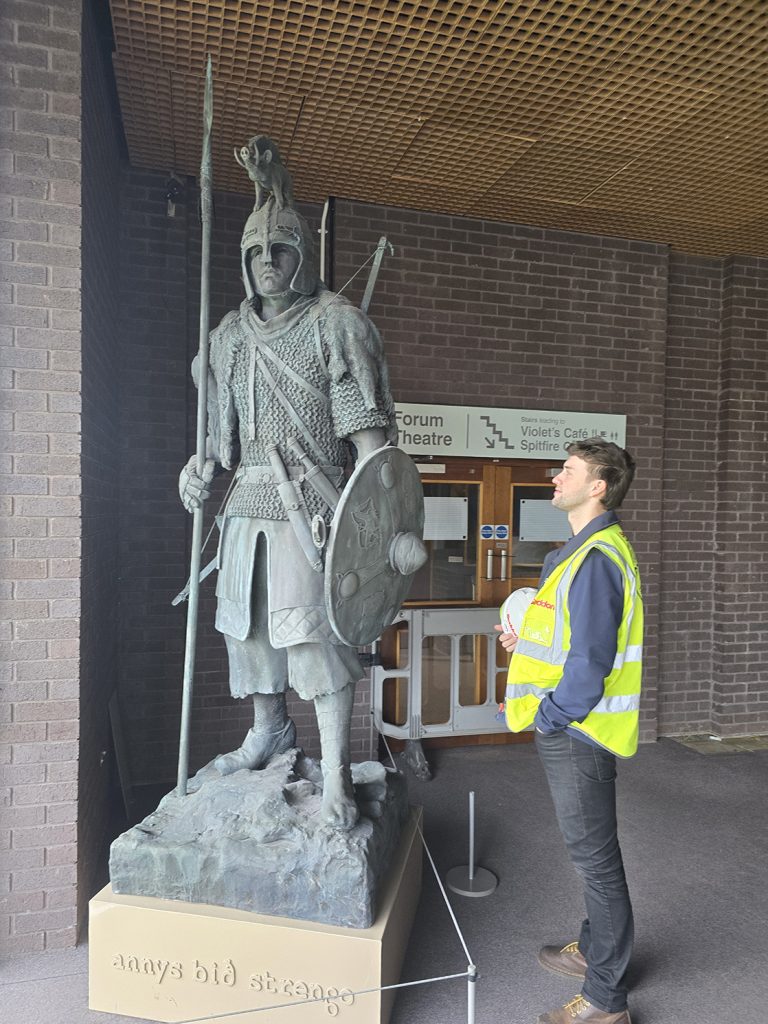
With the first task successfully completed, we turned our attention to the second: relocating an eight-foot-tall statue of a Roman centurion, part of the exhibition about the Lightwood Hoard—not, as many people assume, the Staffordshire Hoard, which was a collection of Anglo-Saxon gold and silver.
Even some 1,600 years after Emperor Honorius withdrew Roman forces from Britain, this centurion was still causing trouble. He needed to be moved because he stood in an area where asbestos-containing materials were due to be removed. Museum staff wanted him taken only a few metres away, into a nearby room—but doing so was far from straightforward.
The centurion had to pass through a standard UK doorway, which, at roughly two metres (six feet six inches) high, was clearly too short for him to walk through upright. Fully equipped with sword, shield, and lance, there was no flat surface that would allow him simply to be laid on the floor. A plan was clearly required.
We began by constructing a raised platform from two stacks of pallets, each three high, to prevent the statue from dragging along the floor. We then cut and shaped multiple pieces of protective packing foam to provide maximum support once the centurion was laid down. Using a long-fork pallet truck, we carefully moved him to his new location.
Once safely in position, we stood him upright again, where he now temporarily guards the Rolls of Honour.
Which leaves just one question: apart from aqueducts, sanitation, roads, irrigation, medicine, education, wine, public baths, fresh water systems, and public order… what did the Romans ever do for us?
Get in touch with us today, please call one of our team
on 0114 261 1183 or email services@specialisedmovers.com

Discover how Specialised Movers completed a complex fireproof safe installation using scaffolding, a HIAB crane, and a first-floor window access solution.

Seahouses Whale Jaw Bones Project The project Specialised Movers first became involved with this project when the Right Whale jaw

From the sea bed to the museum The project Commercial moving can be a hard, challenging job, with crews often

Discover how Specialised Movers completed a complex fireproof safe installation using scaffolding, a HIAB crane, and a first-floor window access solution.
Seahouses Whale Jaw Bones Project The project Specialised Movers first became involved with this project when the Right Whale jaw